A procession of Christmas Eve services comes to my memory at this time of year. For me, singing is the heart of the worship service, as we started out in nativity scenes as shepherds — even as Baby Jesus — as angels, moved on to children’s choir and graduated to senior choir.
That’s how it is when you’re a choir singer. You know the hymns, the anthems and the responses. In fact, you know that the prophetic readings of Isaiah would be ever so much richer as a part of Handel’s “Messiah,” which you sing silently.
I remember the year we learned sight reading in school. It was a heady realization that I could read the lines and dots and zigzags and turn them into music. Every year we impressed three or four verses of Christmas carols into our memories, and they’re still ready to be dusted off.
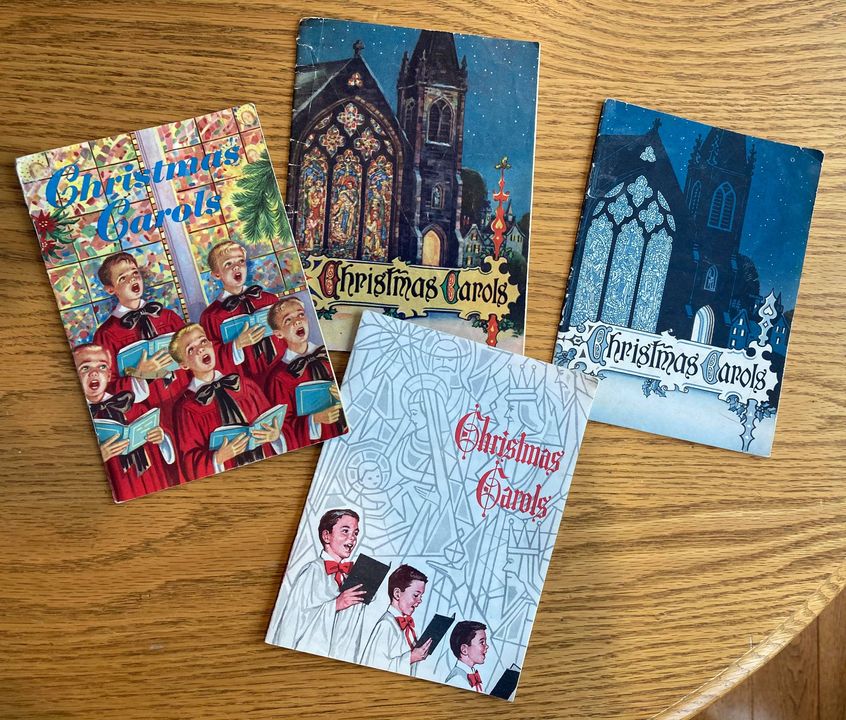 Perhaps the insurance man brought little Christmas Carol books to your house, too. We still use our collection. And we still listen to see who goes for the high note in “The First Noel.” At last year’s holiday party somebody remarked, “This is the only family I know that can improvise harmony in eight parts!”
My mental computer holds thousands of pieces of music, welcome gifts during the hundreds of concerts in which I’ve sung or been in the audience.
Is music part of our DNA? When I learned the story of my ancestor Sgt. Benjamin Waite (1644-1704), I was researching him as “the hero of the Connecticut Valley.” You can read about him in “History of Hadley, Mass.,” Judd, genealogy section, pg 144-145. He was married to Martha Leonard, who, together with her daughters, Martha, Mary and Sarah, was taken captive in Hadley in 1677 and marched to Canada. She was pregnant when she was captured, and she named her daughter Canada when she was born. Sgt. Waite and Stephen Jennings, “men of energy and perseverance,” successfully undertook to redeem their wives and children and the other captives.
As I was researching the history, I couldn’t help wondering whether his surname was an occupational name, like Cooper or Tailor. Indeed, could it have been a family trade? It was seen in the names Waite and Wakeman.
The waites started in medieval times as watchmen, playing their instruments on the streets to assure the citizens that they were on duty and to mark the hours. The usual instrument of the waites was the strident sounding shawm. They also played stringed instruments, hautboys, bass viols, fiddles and bassoons, the instruments we hear in early music.
Using the most portable instrument, they sang, often producing songs named for the town that paid them. The City of York’s Waites records start in the 13th century.
When I think of Benjamin Waite and his father, Thomas Waite, I smile to think that my family carries on the tradition. My long life of singing is not limited to eight decades. I am part of the continuum of music. At Christmas and Easter there is a wealth of music that brings us back farther than the Mayflower’s arrival 400 years ago.
“O Come, O Come, Emmanuel,” a traditional Advent hymn, dates from the 8th or 9th century.
As a member of the Helderberg Madrigal Singers, I learned “I Syng of a Mayden,” also known as “As Dew in Aprille,” from the 15th century.
“God Rest You, Merry Gentlemen,” is said to be one of the oldest extant carols, dated to the 16th century or earlier, to the melody of “In Dulci Jubilo.”
The “Coventry Carol” is an English carol dating from the 16th century. Mothers still sing “Lully, lullay, thou little tiny child.”
The Pilgrims lived in a time that followed King Henry VIII (1491-1547) and his successor, Queen Elizabeth I (1533-1603). It was the Golden Age time of William Shakespeare (baptized 1564-1616) and others whose work is appreciated even today.
Then came James VI of Scotland (1566-1625) also known as James I of England. He was on the throne during the Jacobean era, at the time of the Mayflower’s crossing. The country they left was in turmoil, as Oliver Cromwell wielded the Puritan banner in England.
Back to the 20th century: we owe a thank you to two Minnesota colleagues Art Fry, a choir singer, and his friend, Dr. Spencer Silver, who developed a low-tack adhesive in the lab at 3M in 1968. In 1974, Fry had the idea of using the technology to mark his place in a hymn book. Thank you!
Something there is in human nature that encourages us to embrace our creative talents. We invent, we write, we paint, we sing. In the corners of our memory, we can listen to music of our own lives, stored away for times when we need it. When we sing a carol, we are part of the continuum of the music of many lifetimes. 
So when a song comes to your mind, savor it. Think about it. Hum it. Sing the parts you know and Tra-la-la the words you don’t.
Listen back in time and write on!
Nancy, music lover


 I remember the day my big sister walked me to the library to get my own library card. I could write my name, so I was qualified to go to the branch library in the first floor of the neighborhood school. I remember feeling quite grown up. I wondered whether I could ever have a librarian’s clever pencil with the date stamp affixed!
 Years later, I brought my children to the Bookmobile, stepping into the mysterious time machine. Imagine the library coming to us!
 through city directories, Union College alumni publications and clipping files.
 Addendum: I would be remiss if I didn’t salute my Civil War great-grandfather, Elias Waggoner Ives, who came back to Luzerne after leaving the plague of insects in Nebraska, returning to his native state of New York. Imagine my delight when I learned that he built his house with an entry foyer lined with bookshelves! The first free library in town, his collection became the heart of the village library.


 This year we became Zoom partygoers. Everyone was invited to show an object that had a special holiday meaning. One person showed a beautiful glass French horn ornament. My son hauled out his Royal Racer sled, which elicited howls and laughter about sledding on the notorious local Devil’s Hill. How were we allowed to careen down that steep hill right onto the frozen pond at the bottom? On a sled rimmed with iron! Did our parents know? Well, we may have slid down that same hill, though decades earlier, sitting up or on our bellies.
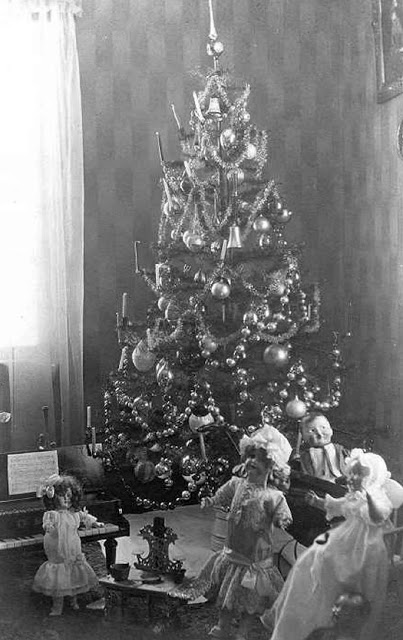 The Christmas tree was the star of the telling, perhaps festooned with popcorn garlands and handmade ornaments. Grandpa Elias had empathy for Christmas trees. One year Elias brought home a tree that was too tall for the parlor. Then, as now, the tree doesn’t always fit the room. He couldn’t bear to lop off the top, so he made room by cutting a hole in the ceiling!